ABC analysis in inventory management is a classification method that ranks every SKU by its annual consumption value and then splits the catalog into three control tiers - A, B, and C. A small share of items usually drives most of the value, so you spend more counting and planning effort where it matters and less where it does not.
If your team currently treats every SKU the same, high-value fast movers hide inside the same task list as low-impact parts that barely move. This guide shows the formula, a clean step-by-step calculation, a worked example, and exactly how to turn the result into cycle counting and replenishment rules you can roll out in a week.
ABC analysis is not about ignoring C items. It is about matching control effort to business risk.
What is ABC analysis in inventory management?
ABC analysis is an inventory classification technique based on the Pareto principle. It sorts SKUs by annual consumption value - how much money flows through each item in a year - and then assigns each one to class A, B, or C. The goal is selective control: high-value items get tight policies, low-value items get simple ones.
Often about 10-20 percent of SKUs that represent roughly 70-80 percent of annual value. Stock errors here hurt revenue, service level, and cash flow quickly.
Usually around 20-30 percent of SKUs and about 15-25 percent of annual value. They deserve structured control, but not daily attention.
Commonly 50-70 percent of SKUs with only 5-10 percent of annual value. They still need standards, just lower counting frequency and simpler review.

These percentages are starting ranges, not strict rules. Your catalog shape, seasonality, and margin profile can shift the split in either direction.
The ABC analysis formula
The core formula is simple and only needs two data points per SKU:
Annual consumption value = annual demand x unit cost
ABC analysis formula
Once you calculate that value for every SKU, you sort descending and compute a running cumulative percent of total value. Items are then classified using threshold bands - typically 80 percent and 95 percent cumulative value - although you can tune those cutoffs to match how your catalog is shaped.
- Class A: SKUs contributing up to ~80 percent of cumulative annual value.
- Class B: The next band from ~80 percent up to ~95 percent of cumulative annual value.
- Class C: The remaining ~5 percent of cumulative annual value, which usually covers the majority of SKUs.
How to calculate ABC classes step by step
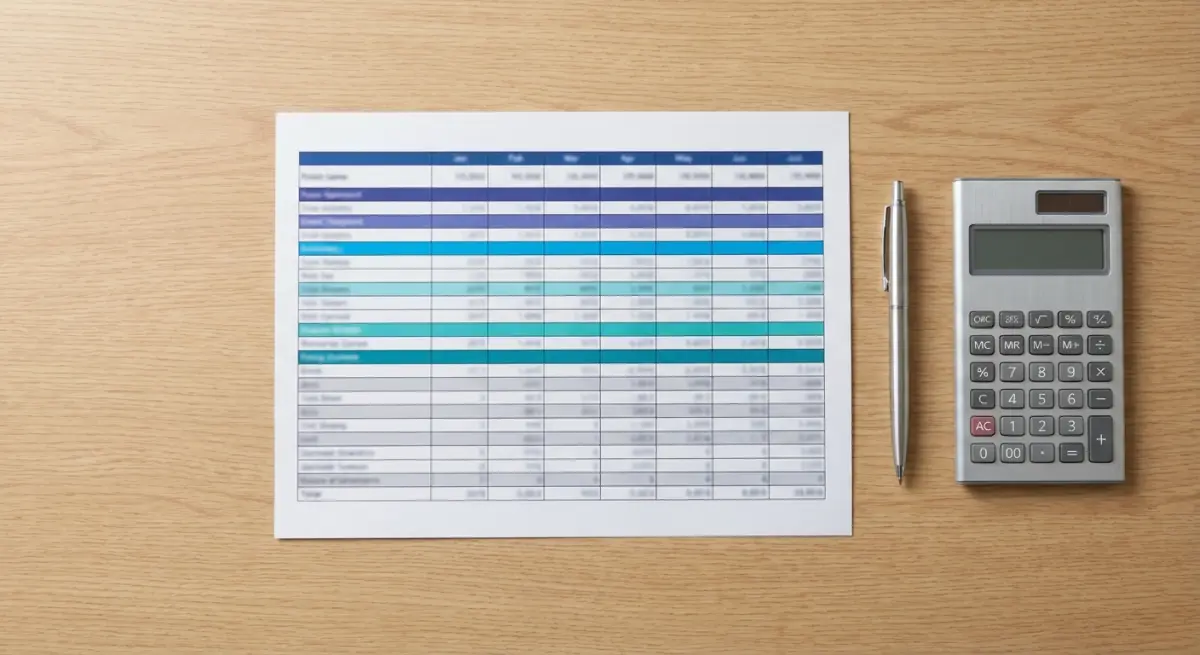
Use a spreadsheet and follow this workflow. You only need SKU, annual demand, and unit cost to start.
- Export your SKU list with annual demand and average unit cost.
- Calculate annual consumption value for each SKU: demand x unit cost.
- Sort SKUs by annual consumption value from highest to lowest.
- Compute cumulative value percent down the sorted list.
- Assign A/B/C based on threshold bands you define (for example 80 percent and 95 percent cumulative value).
- Review outliers with operations context before finalizing classes.
If your demand data looks noisy or heavily seasonal, stabilize it first with a 12-month rolling window. For more on cleaning up the inputs, see our inventory forecasting guide.
ABC classification example
Imagine 10 SKUs with a combined annual consumption value of $500,000. After sorting by annual value from highest to lowest:
- Top 2 SKUs: $390,000 combined (78 percent of total) - classified as A.
- Next 3 SKUs: $85,000 combined (17 percent, cumulative 95 percent) - classified as B.
- Last 5 SKUs: $25,000 combined (5 percent, cumulative 100 percent) - classified as C.
In this example, 20 percent of SKUs generate 78 percent of annual value. That is the Pareto pattern in action, and it is why spending equal time on every SKU is almost always the wrong move.
The objective of classification is focus. You are creating a control map, not a perfect mathematical model.
Operations planning best practice
How to use ABC analysis in inventory management
The classes are only useful once they are attached to specific operating rules. Map each class to cycle counting frequency, replenishment policy, and slotting decisions so the team knows exactly what changes.

Start with A weekly, B monthly, C quarterly. Then tighten or relax by observed variance rates. For a full cadence framework, use our cycle counting schedule guide.
Set tighter reorder points and shorter review windows for A items. Use simpler min-max controls for C items. Pair this with a proper safety stock calculation for A items first.
Place A items in fast, easy-to-count locations to reduce travel and picking errors. Move C items to secondary locations if space is constrained.
The long C tail is the best place to look for dead stock and discontinuation candidates. Our SKU rationalization guide pairs well with ABC results.
Common ABC analysis mistakes
ABC is powerful, but one dimension is never enough for every catalog. Some low-value items are operationally critical, and some high-value items barely move.
- Critical spares problem: A cheap gasket can stop production. Add a criticality flag so it is not under-controlled.
- Margin blind spot: Revenue value can hide low-margin products. Consider contribution margin where possible.
- Seasonality drift: A SKU can move from C to A during peak season. Reclassify quarterly, or monthly in volatile categories.
- Data quality risk: Wrong unit cost or stale demand data will misclassify SKUs. Audit source data before trusting the output.
- Over-engineering: Teams sometimes build complex models before fixing basic receiving and counting discipline. Keep it simple first.
If variances remain high even after ABC rollout, investigate process breakdowns in receiving, put-away, and picking. Our inventory variance guide can help isolate root causes quickly.
ABC analysis rollout plan
Launch ABC analysis in one week
- Day 1 - Data pull:Export 12 months of demand and average unit cost per SKU.
- Day 2 - First pass classification:Calculate annual value, sort, and assign provisional A/B/C classes.
- Day 3 - Cross-functional review:Validate outliers with warehouse, purchasing, and finance.
- Day 4 - Policy mapping:Attach count frequency and replenishment rules to each class.
- Day 5 - Team briefing:Train counters and planners on what changes next week.
- Day 6 - Pilot zone start:Apply the model to one zone or category first.
- Day 7 - Measure baseline:Track IRA, adjustment rate, and stockouts by class.
Frequently asked questions
What is ABC analysis in inventory management?
What is the ABC analysis formula?
What percentage of SKUs are A, B, and C items?
How often should ABC classes be recalculated?
How is ABC analysis different from XYZ analysis?
Can ABC analysis be used for cycle counting?
Final takeaway
ABC analysis in inventory management works because it gives your team permission to prioritize. Not every SKU needs the same control, and pretending otherwise wastes time. Start with the simple annual-value formula, attach clear operating rules per class, and review classifications on a fixed cadence. Within a month, your counting effort should feel lighter and your decisions should feel sharper.